No. 7 - To build a paywall?
- Sara Dingmann

- Oct 5, 2019
- 3 min read
Updated: Oct 6, 2019
Probably one of the strangest emails that I received over the summer at my internship at the Post-Bulletin came from the President of Forum Communications Company, which had just taken ownership of the Post-Bulletin.
The email was basically a hype-up email for the paywalls that were going to be added to all of the newspapers owned by Forum Communications. There were a lot of references in the email to rewriting "the playbook" and how the implementation of paywalls would lead to revenue growth.
I was surprised that none of the papers owned by Forum Communications had paywalls, with the exception of the Post-Bulletin. I had assumed that most newspapers had already adapted some form of a paywall. However, data from Nieman Lab study of 7 countries, 6 European countries and the U.S., suggests that a third of newspapers don’t have any form of paywall. However, the specific number of the U.S. would probably be different because freemiums are not offered here. A freemium is when content is free, but special access or material goods cost extra, according to Investopedia.
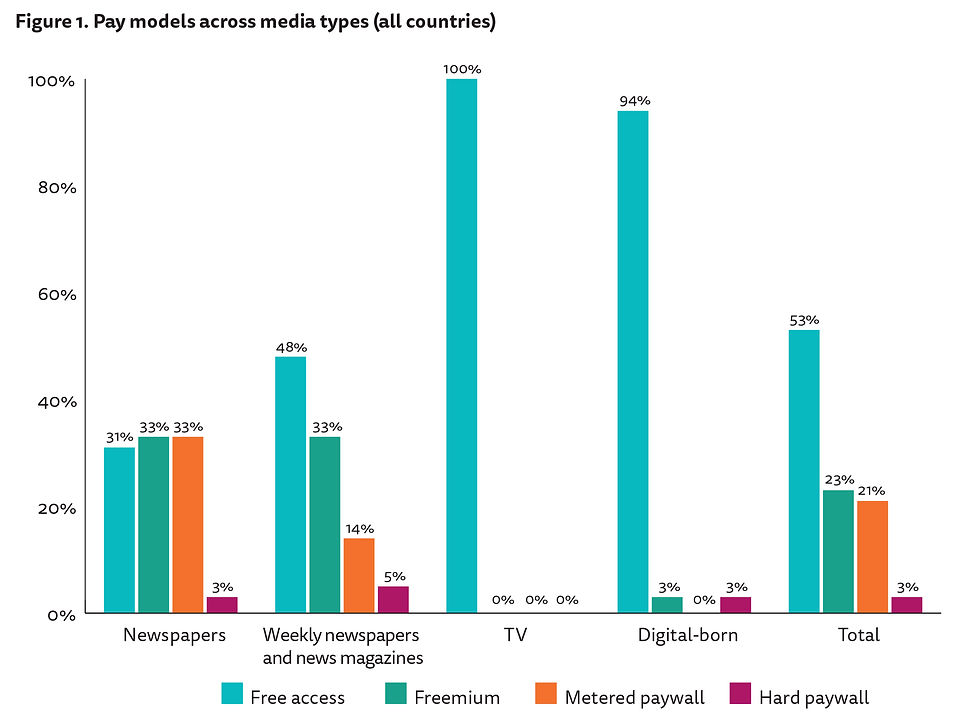
When I took J1100 we spent a significant amount of time talking studying different ways to fund media, so obviously the concept of paywalls was brought up. To me it seemed like a way to keep content online and not lose money, because not many people would be willing to pay for the content anymore. The metered paywall also seemed to be the best, because it allowed people to see what an organization’s content was like. If people weren't able to sample the content, how would they know if they would be willing to pay for it?
In my mind, the only thing that would prevent this system from working would be other news outlets providing free online content. A third of newspapers still do, according to the study by Neiman Lab.
However, after doing some research it may not be as cut and dry as I once thought that it was. In an article about paywalls by Forbes, it was suggested that paywalls would really only be effective for newspapers that offer specialized content.
Similarly, Dean Baquet, the editor of the New York Times, talked about the importance of newspapers finding what specialized content could be provided that no other paper can do at his lecture on Wednesday. Specialization would allow for papers to sell a product people would be willing to pay for is what Baquet said.
Another article from Nieman Lab about the effectiveness of paywalls suggested that papers evaluate audience engagement after the implementation of a paywall. If engagement lowers after the implementation of paywalls, the Nieman Lab suggest that paywalls are probably not the correct solution. If paywalls do seem to be working, the authors suggest making sure that there are slightly less articles available to read for free than the readers would take advantage of. This would allow for news organizations to try and gain more online subscribers, because readers do value the content that news organization produces.
An interesting alternative to paywalls is the survey system adopted by the Missourian in 2014. The system allows for readers to view articles after answering survey questions. The Missourian gets five cents from Google for every survey that is filled out. Google also gets five cents in profits from this system.
Before the Missourian implemented this system, they operated under a 24-hour model, which is yet another different system from what we studied in J1100. I tried to research how many other news organizations have readers answer survey questions to view articles and I was not able to find anything. Besides on the Missourian's website, I have only encountered answering survey questions before being able to view content on YouTube.
It will be interesting to see what systems are adopted to keep generating revenue for any form of news media.I don’t work in the any of the newsroom that are now beginning to implement more strict paywalls under Forum Communications, so I’m not sure how the paywalls will play out for them. The president of Forum Communications seemed to feel that the addition of paywalls would create a new source of income, which it could very well if the readership and engagement of the online sources pays out in the way Nieman Lab suggests that it should for profitability.


Comments