No. 10 - Journalism as a public good
- Sara Dingmann

- Oct 28, 2019
- 3 min read
As I have already talked about, there is a lot of concern about how journalism will be paid for. The invention of the internet changed how people would access information. Suddenly there was a shift to free information provided at everyone’s fingertips. Then there was the birth of citizen journalism, which made news highly accessible.
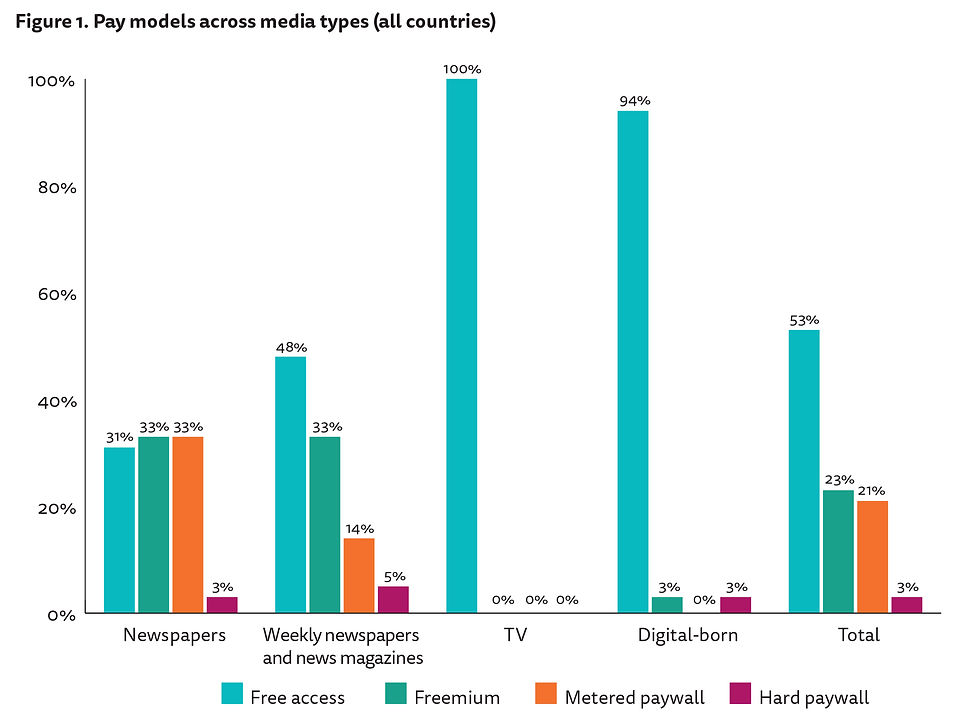
The problem has now become that people are not willing to pay for reporting, because there are many free options for becoming informed.
I would argue that people are not willing to pay for news because it has become a public good. A public good is an economic term that defines a good that does not have to be produced each time one person uses it and you can’t prevent people from using it. With the amount of information that is posted on the internet, people are easily able to access news for free. While there is news produced by journalists that has to be paid for in order to access, the frequency of free news online makes it so that in general news could be considered a public good.
This is a video of Professor Robert McChesney explaining how news media functions as a public good.
In a Nieman Report article, Julia Cagé argues for special privileges for news media because they provide a public good. Cagé’s article does not go as far as to argue for public funding of news media, but she does recognize that new media provides a service of special importance to society as a whole.
There is a lot of fear expressed with the idea that journalism should be paid for by the government. I remember reading an article for J1100 that talked about how people use the First Amendment to shut down any real discussions about publicly funding journalism.
I bring up publicly funding journalism, because that is a viable solution for many public goods. National defense is an example of a public good that would be very difficult to provide in a free market. Not many people are willing to pay for a good that other people might free ride off of, meaning that there are people who get the benefits of national defense without paying anything.
While journalism is a little different in that when one person pays for a service there is a lower likelihood of another person directly benefiting without paying anything, society would be hurt by not having press. The loss of adequate press would be the result of an inadequate funding model.
In many other countries, public news media is widely trusted, according to a Pew Research Center report. Although, this trend has not caught on in the US.
The editor of the New York Times, Dean Baquet, answered a question about public funding of journalism at his master class at the MU’s School of Journalism. He focused on how he has heard about the process the BBC goes through and how he does not see that system as a desirable one. However, I feel that only a handful of media organizations like the New York Times are in a position of going through a system that they desire rather than going through a system that will just keep them alive.
I think it is important to keep news media around to hold governments accountable, and I can see that organizations like NPR are still able to hold the government accountable. I do not have enough information to go into how a system of public funding for journalism would go into effect, but I do feel there should be a more open discussion about this topic.


Comments